
We hear all the time about things a writer
must do to be considered, well, a writer. Primary research, grammar, punctuation, spelling, sentence structure, plot, characterization, and a partridge in a pear tree. All are great things. And all of them are tools that
should be in your tool box. But, if I'm being honest, there are only really two things that a person
must do to be a writer. Careful, now, because I'm about to dispel a lifetime of myths and magick about my chosen craft, and in so doing I could bring the literary world down about my ears.
 |
| Pictured... A world of my making. |
The first thing a person, any person, has to do to be a writer is to simply read. You thought I was going to say something really hard, right? Nope. Reading. If you want to write, you have to read.
 |
| Remember these things? |
And, to be honest, it doesn't really matter what. I've heard people reflect with genre-snobbishness about how they only read their own genre.
I only read horror, they say, because how else could they maintain their fingers on the bloody pulse of what is truly frightening. Fair enough. Wrong, but fair thinking. See, the more you read, the more you can identify what works and what doesn't. The best teachers of the craft are, often, not found in the classroom, but on the shelves. Read the masters of your craft, not just in your chosen genre, but in
all genres. For example: I write horror.
 |
| Yes, really. Ass. |
And, to me, the Gods of Horror are a very short list: Richard Matheson, Steven King, Clive Barker, H.P. Lovecraft, E.A. Poe, Algernon Blackwood, and Gary Braunbeck. But if I only read those authors (and there is enough from them to fill a lifetime, I assure you), I would become a very one-dimensional writer. In case you were wondering, I also read the works of Douglass Adams, Dashiell Hammett, J.R.R. Tolkien, Frank Herbert, William Gibson, and a few that I won't name because they might tarnish my already crumbling reputation as a scary guy.
 |
| No. |
I also read procedurals, books on psychology, on magick and lore, books on other cultures and ghost stories. I read books about cooking, motorcycle repair, biographies (anything on Harpo Marx, Charlie Chaplain, or Boris Karloff earns a place on my shelf) and
autobiographies (particularly of pro wrestlers, for some reason... Don't judge me, you bastards). And numerous other things that give me insight into how to tell a story, how to form a linear progression, how to give the reader the experience I want. These are my teachers. These are the masters. I fall at their feet and soak up everything I can, and in the process, I hope to become a better writer.
 |
| Pictured: A Master. |
So that's it. Thing one that every writer must do is read. Simple really, yet I often am surprised at how many wannabe writers casually quip "Oh, I don't read. I don't want to sully my creative process with other people's stuff." Seriously, I've heard that. And I laugh at it. On this point, I am inflexible. If you want to be a writer, you need to read. You either believe that, or you're wrong.
 |
| Only two types of people... |
Which brings me to thing number two that all people must do to become professional writers. It's a little tricky, maybe a little outside-of-the-box, so follow me on this one. Place butt in chair and fingers to keyboard. It's a two parter, so let's break that down. First, butt in chair:
 |
| You know who you are. |
One of the hardest things to get a writer to do is to actually
sit down and write. We'll go out of our way to do things that we thing we
should be doing. Dishes, laundry, cleaning out the garage, making warm boxes for neighborhood strays... But the truth is, if you want to be a writer, you have to treat your writing like something other than just a whimsical hobby. It isn't. It's a
job. And a damned hard one at that. Think about how long it takes to churn out a serviceable manuscript. Months! Even if you're an obnoxiously prolific writer, it still takes time out of your schedule to tell your story, doesn't it? And, yes, all those other things have to be done as well, but this is your job! This is your passion! This is your craft! SO PUT YOUR ASS IN YOUR CHAIR. Create a schedule and post it in the main room of your living area. On that schedule, block out a section of time that says "Between the hours of -insert your hours here-, under pain of death and flogging with a wiffleball bat, none may disturb THE AUTHOR as he/she is working!" Then stick to it. Let nothing distract you from your vocation.
 |
| No, not even him. |
Your chair is your throne, your office equipment, your business, and your sole property. Don't let people stack the mail there. Don't let anyone just sit behind your desk for a moment. It's your vocation they're screwing with. Take it seriously. You have to. Get yourself a chair upon which you can sit comfortably, and claim it as your own.
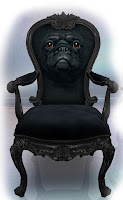 |
| Awww yis! |
Which brings me to the other part: Put fingers to keyboard.
 |
| Like this. |
Okay, so some of you still write longhand, so put a pen/pencil in your hand and get to work, but you get what I'm saying here. Once your butt is firmly planted in your chair, it's work time. Not hey-I'll-just-check-my-email time. Not I-wonder-what's-happening-on-social-media time. It isn't time for your to browse Reddit, or Facebook, or Youtube. It isn't even time to just check the hockey scores for a few minutes (GO PENGUINS). It's time to work. It's time to, you know, WRITE. How will you ever be considered a writer if you don't, y'know, actually write something?
The other things mentioned at the top of this picture-laden blog entry will make you a good writer. But before you can become a good writer, you must first become a writer. No one is born good. No one is born with a backlist. Ray Bradbury said once that your imagination is just like any other muscle in your body, and you must treat it as such. If you exercise it daily, it will grow in strength. If you don't, it will atrophy and die. Truer words were never spoken. There's another saying among painters (I think) that my wife is fond of quoting. To say it in my own words (because I never get the phrasing exactly right), inspiration is for amateurs. Professionals show up and get to work. What that means, to me, is that, if you wait for inspiration to strike (or for the muse to leave little idea-turd on your shoulder), you're unlikely to get a story finished, much less make a career out of this. If you carve out a time for yourself and treat this like a profession, you will at least have a fighting chance.
So that's it. That's all you have to do. Read. Read everything. Read until there's nothing left to read (which will never happen). Then write. Pour your soul on the page. That's what we do, after all. When it's all said and done, the only thing we writers really have to do is open a vein and bleed all over the page. I stole the last graphic in this post from another blog (
http://www.thebeginningwriter.com/) because it perfectly illustrates the point I'm trying to make, and I've pinned it to my Pinterest board. Yes, I have a Pinterest board. No excuses. You either want to be a writer, or you don't. If you want to, but can't be bothered to read, can't be troubled to put your ass in your chair and your fingers to the keyboard daily, then you really can't want it badly, can you?
 |
| Now get to work. |

 We hear all the time about things a writer must do to be considered, well, a writer. Primary research, grammar, punctuation, spelling, sentence structure, plot, characterization, and a partridge in a pear tree. All are great things. And all of them are tools that should be in your tool box. But, if I'm being honest, there are only really two things that a person must do to be a writer. Careful, now, because I'm about to dispel a lifetime of myths and magick about my chosen craft, and in so doing I could bring the literary world down about my ears.


